Carpet, built-up, super built-up: what you are actually paying for
Three numbers describe the same home, and they can differ by a third. Here is how each one is measured, why RERA settled on carpet area, and the one sum worth doing before you compare two projects.
By NB Sales Desk

Ask three people how big a flat is and you can get three honest answers. A brochure might say 2,150 square feet, the agreement 1,560, and the tape measure in your living room something close to the second number. Nobody is lying; they are measuring different things: carpet area, built-up area and super built-up area.
Before 2017 this was the single most common source of disappointment we heard from buyers across Ahmedabad. Since RERA it has become easier to see through, but only if you know which number you are looking at.
The three measures, in plain words
Carpet area
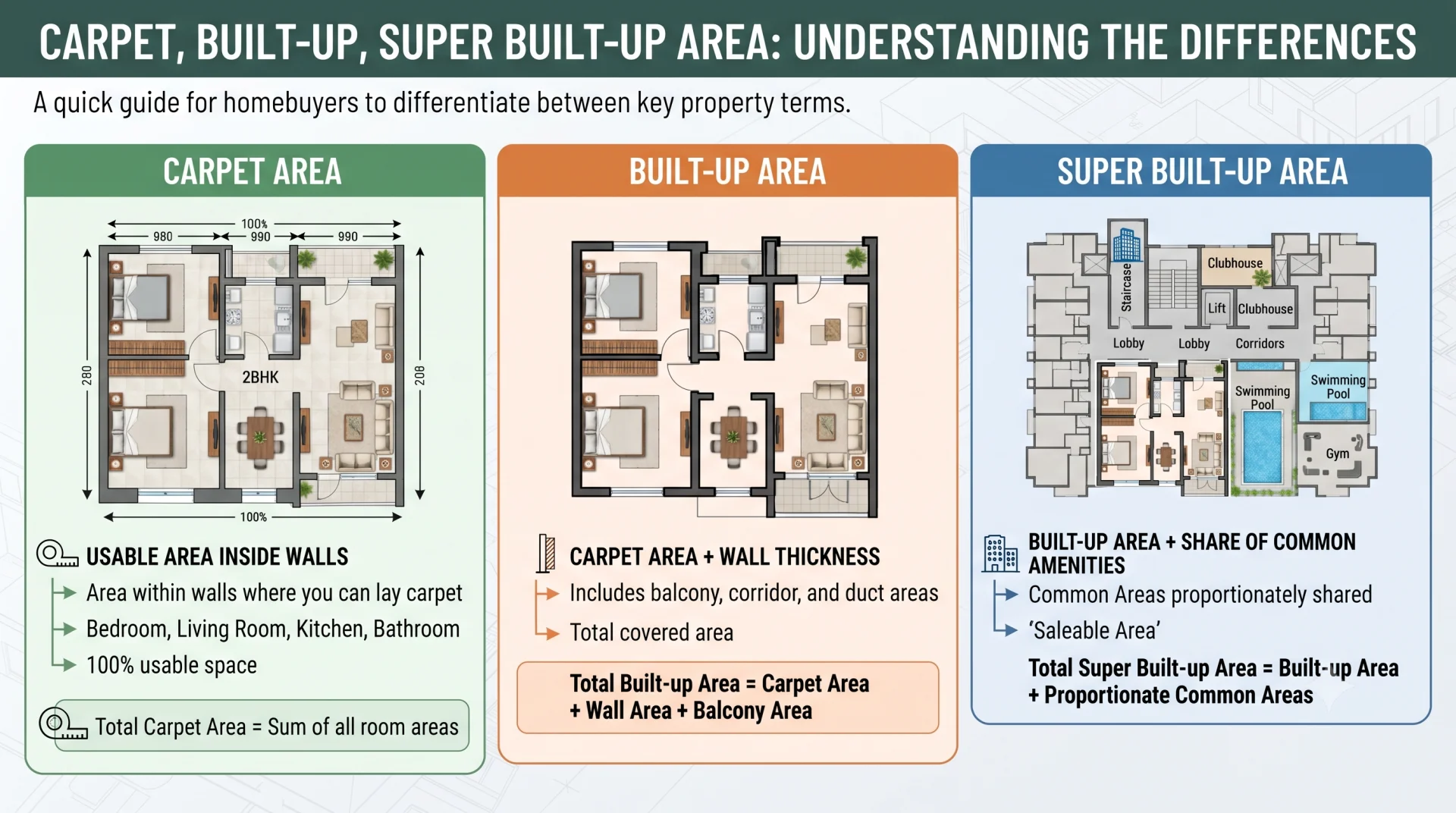
The floor you can actually use inside your home. Under the Real Estate (Regulation and Development) Act, 2016, carpet area is the net usable floor area of the apartment, excluding the external walls, service shafts, your exclusive balcony or verandah and any exclusive open terrace, but including the internal partition walls.
If you could lay a carpet on it, it counts. That is the easiest way to remember it.
Built-up area
Carpet area plus the thickness of the walls, plus balconies and any dry terrace that belongs only to you. In most well-planned towers this is roughly 10 to 15 percent more than the carpet area.
Super built-up area
Built-up area plus your proportionate share of everything you use but do not own alone: lobbies, staircases, lift cores, the clubhouse, the gym, the podium garden, sometimes the security cabin at the gate. The difference between carpet and super built-up is called the loading, and it commonly runs anywhere from 25 to 45 percent.
Why RERA settled on carpet area
Loading is not a trick in itself. A tower with a double-height lobby, a pool deck and wide corridors genuinely costs more to build, and someone has to pay for it. The problem was that loading was invisible, and two flats advertised at the same super built-up size could hide very different homes.
RERA fixed the part that mattered. A developer must now state the carpet area in the agreement and on the project’s registration page, and price is quoted against it. Super built-up figures still appear in conversation, and some brochures still print them, but the number you are legally buying is the carpet area.
The one sum worth doing
When you are comparing two projects, convert everything to an effective rate per square foot of carpet area. It takes a minute and it removes almost every illusion in a price sheet.
Take two projects advertised at the same 2,000 sq ft super built-up area:
- Project A quotes ₹7,200 per sq ft, a total of ₹1.44 crore, for 1,480 sq ft of carpet area. That is an effective ₹9,730 per sq ft of carpet.
- Project B quotes ₹6,800 per sq ft, a total of ₹1.36 crore, for 1,300 sq ft of carpet area. That is an effective ₹10,462 per sq ft of carpet.
Illustrative figures only.
Project B looked ₹8 lakh cheaper. Per square foot you can actually use, it is about 7 percent dearer. Neither project is necessarily the better one; A may simply have fewer amenities. But now you are comparing the same thing.
What to check on the site visit
- Ask for the carpet area per room, not just the total. A good sales team has a room-by-room schedule.
- Walk the sample flat with the plan in hand. Is the balcony you are standing on counted in the carpet area? Under RERA it should not be.
- Ask what the loading pays for. A clubhouse you will use is worth something. A second lobby you will never see is not.
- Check wall thickness. Thicker external walls cost you built-up area, but they keep the flat cooler through an Ahmedabad May.
- Match the agreement to the RERA page. The carpet area in both must be the same figure. Every registered project in the state is listed on the GujRERA portal; our guide to reading a RERA page shows where to find it.
How we quote. Every NB price sheet states the RERA carpet area first, with balconies and terraces listed separately beneath it. If a figure on any of our documents is unclear, ask the site team to walk you through it room by room, or run the total through our EMI calculator before you visit.
Carpet, built-up and super built-up: the short version
- Carpet area is what you live on, and it is what RERA makes developers state.
- Loading is normal; unexplained loading is not.
- Divide the total price by the carpet area before you compare any two homes.