Inside a slab cycle: how a tower rises one floor at a time
From the ground a tower seems to grow in bursts. On site it grows to a rhythm: formwork, steel, services, concrete, curing, repeat. Here is one floor, day by day, and the checks that happen before anyone pours.
By NB Site Team

Every tower rises one slab cycle at a time. Stand across the road from a tower under construction for a month and you will see it climb a floor every week or so. What you will not see is the choreography behind each of those floors, repeated thirty times over, with the same checks every time.
We call it the slab cycle. On an NB site it runs on a steady rhythm, and the rhythm is the quality control.
The slab cycle, one floor day by day
- Days 1-2 · Formwork. The wall and slab moulds are lifted from the floor below and fixed in place. System formwork, aluminium panels made for this building, means every floor is cast to the same dimensions as the last.
- Days 2-4 · Reinforcement. Steel is cut and tied to the structural drawings. Cover blocks hold it the right distance from the mould, because the concrete around steel is what protects it from rust for the next sixty years.
- Days 3-4 · Services. Electrical conduits, sleeves for plumbing and openings for ducts go in before the pour. Getting them right now means no one breaks a finished slab later.
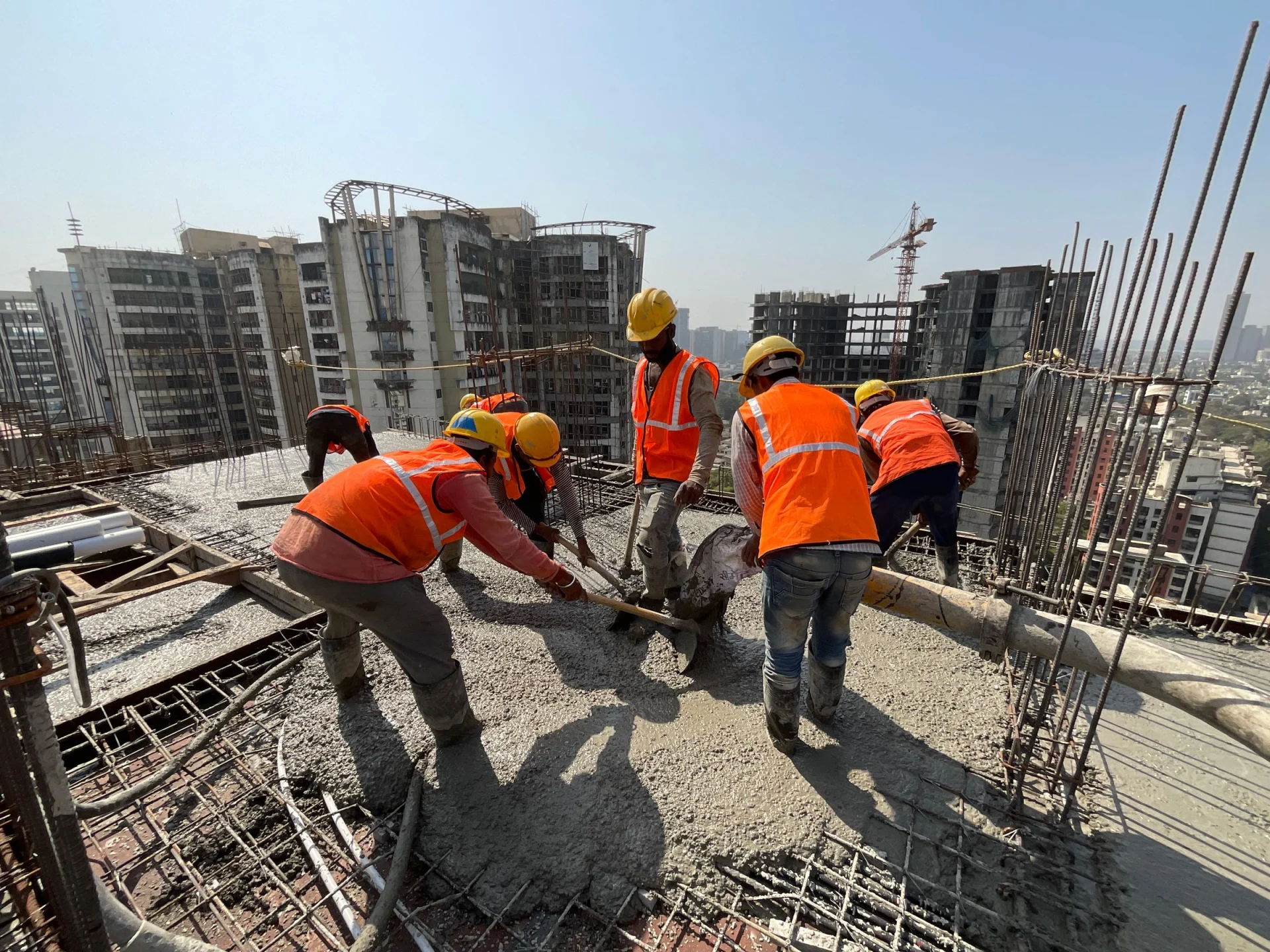
- Day 5 · Checks, then the pour. The site engineer and the structural consultant’s representative sign off the steel and the formwork. Only then is concrete poured, vibrated and levelled, with sample cubes taken from the same batch.
- Days 6-13 · Curing. Concrete gains strength slowly, and only if it stays wet. The slab is kept moist for at least seven days, longer in the dry heat of an Ahmedabad summer.
The cubes that decide everything
From every pour, sample cubes are cast and sent to be crushed, as the Indian Standard for concrete set by the Bureau of Indian Standards requires: some at seven days, the rest at twenty-eight. The results are recorded against the floor they came from. If a set falls short, the floor is investigated before anything more is built on it.
Why the slab cycle is the quality control
A fixed rhythm is not about speed. When every floor follows the same steps in the same order, a missed check stands out at once: a slab cannot be poured until the steel is signed off, and the next formwork cannot go up until the curing days have passed. The repetition turns quality from something a site promises into something it records, floor by floor, for the whole height of the tower.
Why the props stay
Side moulds come off within a day or so, which is why a tower can move so quickly. The props beneath the slab stay much longer, and the floors below keep supporting the ones above until the concrete has reached its design strength. This is the part of the cycle that is tempting to rush, and the part that must never be.
What it means for the home you buy
- Straight walls and level floors, because every floor was cast in the same moulds.
- Fewer cracks, because curing and de-propping were not hurried.
- A record. Test results exist for the floor you will live on.
Questions to ask on a site visit
You do not need to be an engineer to judge a slab cycle. A few questions, asked politely on site, tell you a great deal:
- How many days per floor? A steady seven to ten is healthy. Much faster, ask how the curing keeps up.
- Where are the cube results kept? A good site can show you the register for any floor.
- How long do the props stay? The answer should be in weeks, not days.
At NB Legacy Tower the site team will answer all three, with the register open.
Visit a live site. Buyers are welcome on NB sites with the site team, in safety gear, on weekday mornings. Ask to see a pour if one is scheduled.